

The Science · A Beginner's Guide
Light Your Skin Can Use
Red light therapy sounds futuristic, but the idea is simple: certain colours of light carry energy your cells can absorb. Here's how it works explained from scratch, no science degree required.
What red light therapy actually is
Red light therapy is the use of specific, gentle wavelengths of red and near-infrared light, delivered by LEDs, to support your body's own everyday processes. You'll also see it called photobiomodulation (PBM) or low-level light therapy different names for the same idea.
It uses no UV, so it isn't a tanning light or a sunbed. The light is bright and warm rather than hot, and a typical session is short around ten minutes.
How your cells turn light into energy
Inside almost every cell sit tiny structures called mitochondria the power stations that keep the cell running. One part of that power station contains a light-sensitive molecule (its name is cytochrome c oxidase) that behaves a little like a microscopic solar panel.
When red and near-infrared light reach it, researchers believe it helps the mitochondria produce more ATP the fuel cells use to repair, renew and do their jobs. The same light can briefly prompt blood vessels to widen, easing the flow of oxygen and nutrients to the area.
Why red and near-infrared specifically?
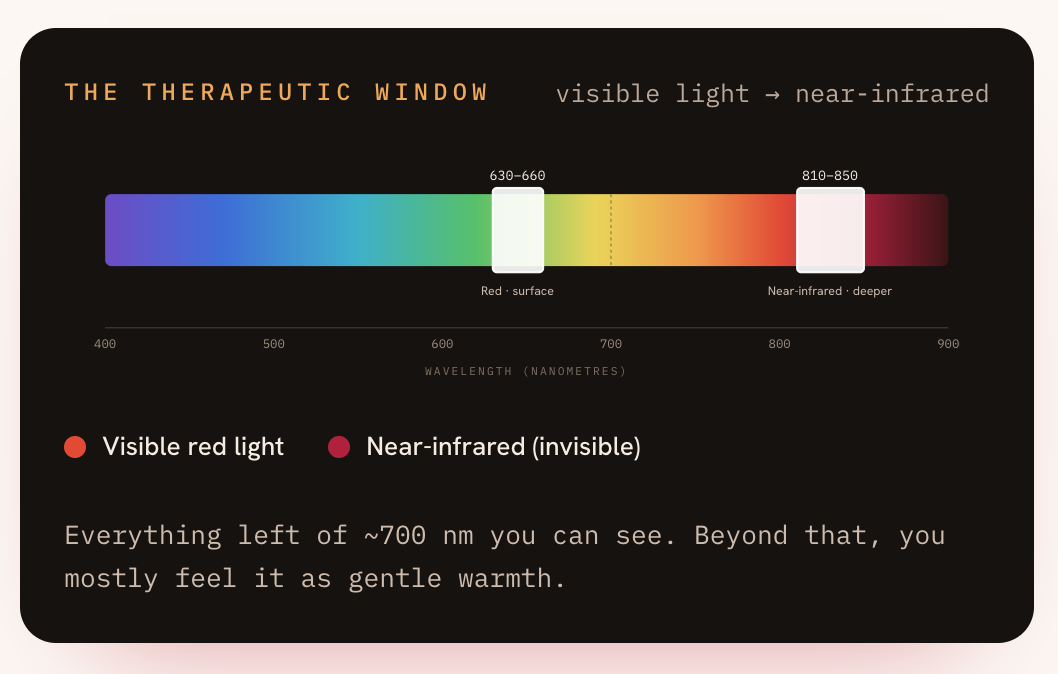
Not every colour of light can do this. Most is either reflected, scattered or absorbed before it reaches the cell. Red and near-infrared sit inside a sweet spot often called the therapeutic window where light passes into the skin well and is absorbed by exactly the right targets.
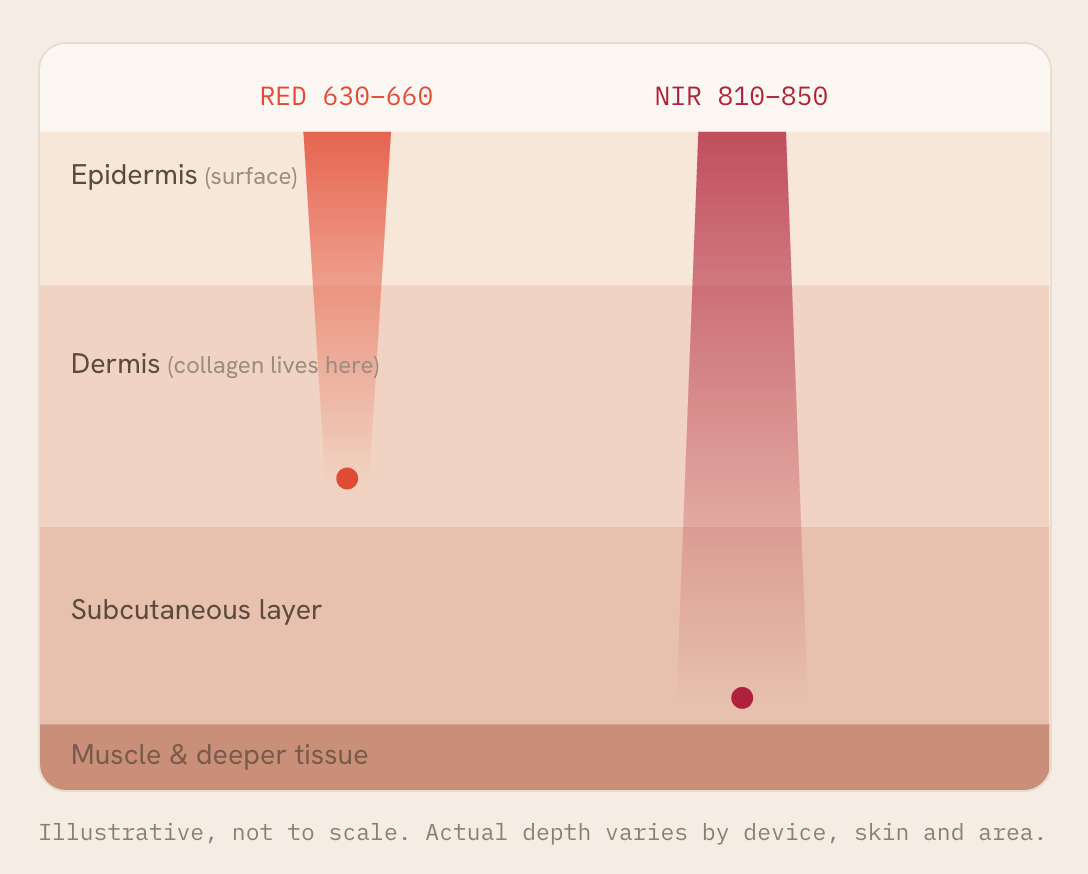
The longer the wavelength, the deeper it tends to travel. Visible red (around 630–660 nm) works mainly at the surface, which is why it's associated with skin tone and texture. Near-infrared (around 810–850 nm) is invisible to the eye and reaches deeper tissue, which is why it's linked with recovery and comfort. Many devices combine both. See the diagram below.
Depth & Purpose
Different Depths, Different Jobs.
This is the simplest way to understand a device's wavelengths. Surface-level red light is generally chosen for the look of skin tone, texture and the collagen-rich dermis.
Deeper-reaching near-infrared is generally chosen for how you feel, recovery, comfort and relaxation.
What the research has explored
Promising Areas Described Honestly
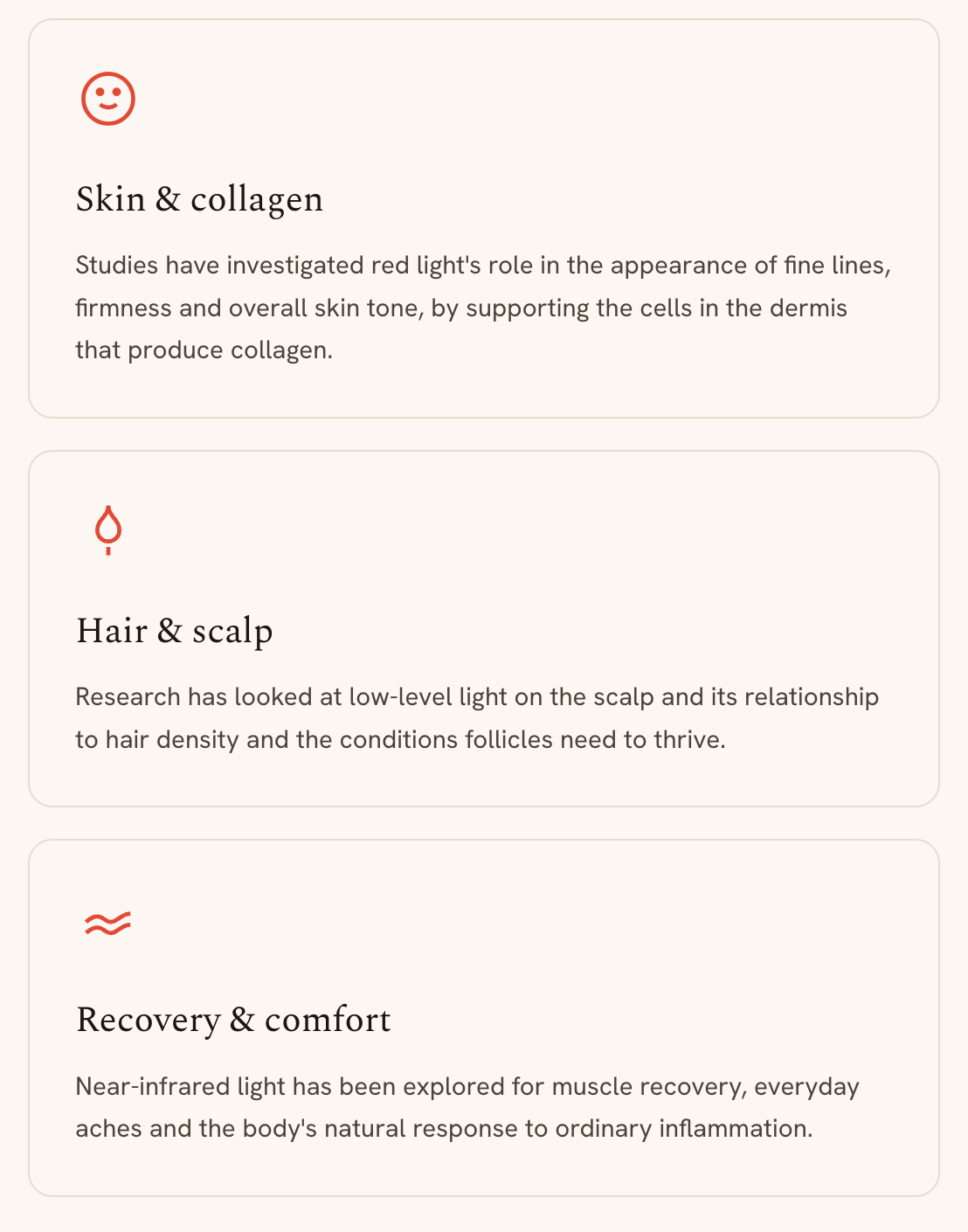
Red light therapy has been studied for decades. Evidence is strongest in some areas and still developing in others, and results vary from person to person. Here's where the science has focused.
Why a little & often wins
More isn't Better. Consistent is Better
Light therapy follows what scientists call a biphasic dose response: too little does very little, the right amount helps most, and piling on more doesn't add extra benefit. That's why sessions are short and designed to be repeated — a steady ten-minute ritual tends to serve your skin far better than the occasional marathon.